
Caring for Aging Parents
As our nation ages, many Americans are turning their attention to caring for aging parents.


If you are part owner of an investment property with other owners and you want to know if you can do a 1031 exchange? This article will outline if you can 1031 Exchange Multiple Owners into a replacement property, or into a Delaware Statutory Trust. The short answer is yes, you can 1031 Exchange Multiple Owners. If you are looking to 1031 Exchange with Multiple Owners, you will want to ensure that all parties involved are willing to sell the property. Once all parties have agreed to sell the investment property, you can list the property for sale. Prior to the investment property closing escrow, you need to setup your qualified intermediary account. Setting up your qualified intermediary account will allow the tax deferred exchange of your investment property proceeds. Once the funds are sent to the qualified intermediary, you now have options for each investor. You can have all owners do a 1031 exchange into a like kind property.
If you have owners in the investment property that do not want to continue owning physical real estate, you have some options once the proceeds are at the qualified intermediary. The Delaware Statutory Trust is a great way for real estate owners who do not want to continue owning real estate to defer their capital gains tax. For those who are not familiar with the Delaware Statutory Trust, you can read a full - Delaware Statutory Trust Guide by clicking the link and learning more. The Delaware Statutory Trust (DST) is a great way to split up the investment proceeds without having to be subject to the long term capital gains tax. For example, you can have 4 investors in one property. 1 owner can defer the capital gains tax into the DST, receive passive monthly income, depreciation benefits, and potential appreciation. 1 owner can take the proceeds in cash, and pay the capital gains tax. The other 2 owners can 1031 exchange into a physical property and continue to manage that property. There are many ways to cut the pie when looking to 1031 Exchange Multiple Owners. We have handled many 1031 Exchange Multiple Owners into the DST structure for those who did not want to continue to manage physical properties anymore.
We will dive deeper into the topic of 1031 Exchange Multiple Owners for a more complicated breakdown. If you are a real estate investor with multiple owners, and looking to do a 1031 exchange, please fill out the contact form below, click any of the contact links, or call our office directly at 805-603-4378 to learn more about our process. We can assist you with your 1031 Exchange Multiple Owners into a Delaware Statutory Trust, so you do not have to pay the capital gains tax.

**The properties depicted here are representative examples of the types of property that can be owned within a DST. They are not intended to depict or represent any particular investment offering.
A 1031 exchange, as defined under Section 1031 of the Internal Revenue Code, allows real estate investors to defer capital gains taxes by reinvesting the proceeds from a property sale into a like-kind asset. However, when multiple parties share ownership of a property, executing a 1031 exchange becomes more complex. The feasibility of an exchange depends primarily on the ownership structure. This article delves into various ownership scenarios, real-world examples, and strategic considerations to optimize tax deferral through a 1031 exchange.
The manner in which a property is owned dictates whether multiple owners can participate in a 1031 exchange collectively or individually. Below are common ownership structures and their implications for 1031 exchanges.
Under a TIC structure, each owner holds a proportionate and undivided interest in the property. Because the IRS recognizes each TIC owner as an individual taxpayer, each party retains independent control over their share, enabling them to:
Conduct an independent 1031 exchange on their ownership portion.
Opt to sell and recognize capital gains separately.
Reinvest proceeds into different properties, independent of co-owners.
Sarah, Mark, and John hold TIC ownership of a commercial building valued at $1.2 million. Sarah elects to execute a 1031 exchange on her $400,000 share, rolling it into another investment property. Meanwhile, Mark and John choose to cash out and recognize their respective capital gains.
When a property is held under an LLC or partnership, the entity itself—not the individual partners—owns the asset. Consequently, unless the entire entity undertakes a 1031 exchange, members cannot independently defer taxes on their respective shares.
One common strategy to circumvent this limitation is the "drop and swap" approach, wherein:
The LLC distributes ownership shares to individual members, restructuring ownership as tenants in common prior to the sale.
Once reclassified as TIC owners, each member can choose to execute a 1031 exchange or cash out.
ABC LLC, comprising three partners, owns a multifamily complex valued at $2 million. Two partners prefer to liquidate, while Lisa wants to reinvest using a 1031 exchange. To accommodate all parties, ABC LLC dissolves, distributing ownership as TIC. Lisa proceeds with a 1031 exchange, while the other two partners take their gains.
A joint tenancy arrangement presents additional challenges, as all owners share equal ownership rights. To qualify for a 1031 exchange, all joint tenants must unanimously agree to reinvest. If one or more owners choose to cash out, those seeking to exchange must first buy out the departing owners prior to the sale.
Tom and Jerry co-own a retail property as joint tenants. Tom wishes to perform a 1031 exchange, whereas Jerry intends to liquidate. To facilitate the exchange, Tom buys out Jerry’s share before the sale, allowing him to reinvest the entire property value tax-deferred.
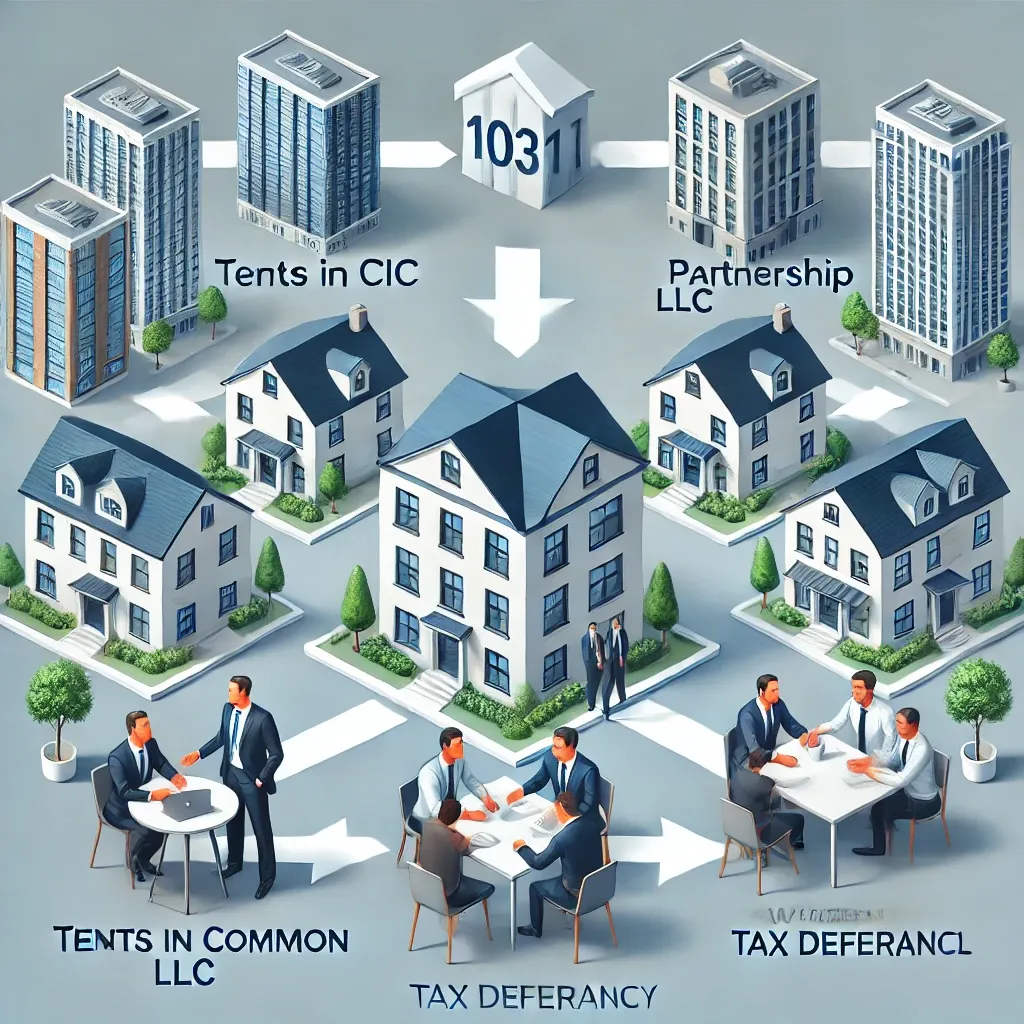
Proactive Planning: Structuring property ownership as tenants in common from the outset enhances flexibility for future 1031 exchanges.
Engage a Qualified Intermediary (QI): The IRS mandates the use of a QI to facilitate tax-deferred exchanges.
Legal and Tax Compliance: Engaging real estate attorneys and CPAs ensures compliance with IRS regulations, particularly for strategies like drop and swap.
Transparent Communication: Co-owners should establish clear exit strategies to prevent disputes and streamline transactions.
If you are looking to sell an investment property with multiple owners and do a 1031 exchange, please contact us. We can help you with a reputable qualified intermediary. Our team can help lay out a strategy for the multiple owners in the 1031 exchange. For those looking to get passive income from the 1031 exchange, we can help guide you on the DST process in order to defer your capital gains tax.

**The properties depicted here are representative examples of the types of property that can be owned within a DST. They are not intended to depict or represent any particular investment offering.


As our nation ages, many Americans are turning their attention to caring for aging parents.

Social media may be a modern imperative for businesses looking to grow and build their brand, but it also introduces risk.

The right executor may help ensure the distribution of your assets is done with as little upheaval as possible.

It can be difficult for clients to imagine how much they'll spend in retirement. This short, insightful article is useful.

Use this handy, informative article to help your clients understand Qualified Charitable Distributions (QCDs).

Good employee health can be great for the company’s bottom line.

Learn about the rise of Impact Investing and how it may benefit you.

Learn how to tell the difference between purchases that reflect your priorities and those driven by habit or pressure.

Simple systems can help you spend with purpose year-round, without relying on constant willpower to stay on track.